Video Transcoding & Broadcast Pipelines
We design and operate professional video transcoding systems — HLS, LL-HLS, CMAF and DASH delivery, IMF and ProRes mastering, batch processing of master copies of any size, AI-driven ad-break detection, microservice architectures with workers and AI agents, and hardware-accelerated transcoding on CPU, GPU and specialized VPUs such as NETINT.
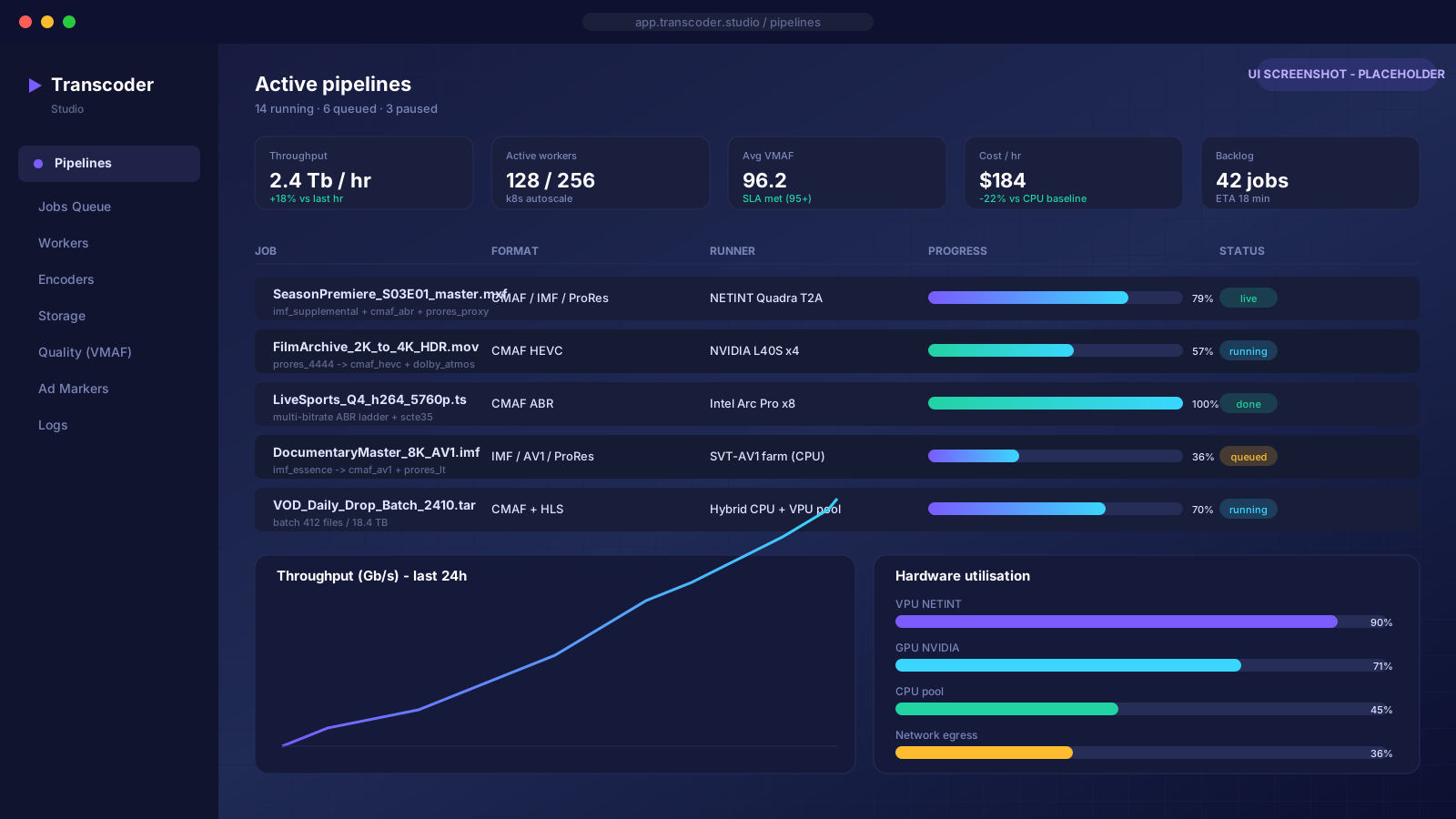
Multi-format transcoding: HLS, CMAF, DASH, IMF, ProRes
We build transcoders that speak the language of modern broadcast and OTT. From HLS for Apple devices and Smart TVs, low-latency CMAF and DASH adaptive streaming with per-title bitrate ladders, to IMF interoperable mastering and ProRes mezzanines for post-production — your content moves between formats without quality loss, with deterministic timing, frame-accurate cuts and fully audited metadata.
Behind the scenes we work with the actual specifications: ISO/IEC 23001-7 Common Encryption (CENC) for cross-DRM packaging, MPEG-DASH (ISO/IEC 23009-1) with SegmentTimeline and SegmentTemplate, RFC 8216bis for HLS, ISO/IEC 23000-19 for CMAF, SMPTE ST 2067 for IMF and SMPTE ST 2110 for SDI/IP broadcast. We pick the right manifest type, segment duration, codec profile, level and tier — and document every decision so your operations team can reproduce, scale and ship it.
- HLS / CMAF / DASH packaging with ABR ladders and per-title encoding for optimal quality at every bitrate, on every device.
- IMF (Interoperable Master Format) ingest and assembly with CPL/PKL/OPL handling and supplemental packages.
- Apple ProRes 422/4444/HQ/XQ mezzanines, DNxHR/DNxHD, JPEG 2000 and uncompressed mastering.
- Frame-accurate audio mapping (5.1 / 7.1 / Dolby Atmos), closed captions, SCTE-35 markers and full SMPTE compliance.
HLS streaming deep-dive: LL-HLS, FairPlay & Interstitials
HLS remains the dominant streaming protocol — from Apple TV and iOS to Smart TVs, set-top boxes and Android. We build HLS pipelines that cover every flavour: legacy MPEG-TS for maximum device compatibility, fMP4/CMAF for modern players, Low-Latency HLS for real-time delivery, and FairPlay Streaming for premium-content protection. One pipeline, every screen, predictable behaviour.
For Apple's HLS Authoring Specification (Tier 1) we deliver multi-rendition manifests with IMSC1 subtitles, AAC LC and AC-4 audio variants, HEVC Main 10 with Dolby Vision profile 8.4 and HDR10 fallbacks. For LL-HLS we tune partial segment duration (200-500 ms), part-target value, EXT-X-PART independent flag, EXT-X-PRELOAD-HINT for the next part, and the blocking playlist reload via _HLS_msn / _HLS_part query parameters. The result: a manifest your players love and Apple's mediastreamvalidator approves on the first run.
- LL-HLS (Low-Latency HLS) with partial segments, EXT-X-PART, preload hints and blocking playlist reload — sub-3-second glass-to-glass latency for live events.
- fMP4/CMAF-based HLS with byte-range delivery and common-encryption (CENC) — shared segments across HLS and DASH, fewer files and lower storage cost.
- HLS Interstitials for stitched live ads, server-guided mid-rolls, dynamic ad replacement and content slates — without breaking the player session.
- FairPlay Streaming, AES-128 and SAMPLE-AES encryption, multi-DRM with Widevine and PlayReady — Hollywood-grade content protection for live and VOD.
CMAF and chunked low-latency streaming
CMAF (Common Media Application Format, ISO/IEC 23000-19) is the foundation of modern adaptive streaming — one set of fMP4 segments, one common initialization, two manifests (HLS and DASH). We design CMAF asset structures that play on iOS, Android, browsers and Smart TVs from a single origin, with bit-identical content and significantly reduced packaging cost. Less duplication, lower CDN bills, simpler audits.
For low-latency we go beyond the spec: CMAF chunks of 200 ms, HTTP Chunked Transfer Encoding (CTE) at the origin and the CDN, DASH SegmentTimeline with $Time$ addressing, availabilityTimeOffset tuning, and player-side adjustments for chunk-aligned ABR switching. Combined with HTTP/2 (or HTTP/3 / QUIC) and a properly tuned CDN cache, we hit 2-4 second end-to-end latency with full ABR — comparable to LL-HLS, with broader player support and a single asset graph.
- CMAF asset structuring with common-init, common-encryption (CENC) and shared fMP4 segments — one library, every player.
- Low-Latency CMAF (CMAF-LL) with chunked CTE delivery, DASH SegmentTimeline, availabilityTimeOffset and player tuning for chunk-aligned ABR.
- CMCD / CMSD (Common Media Client/Server Data) headers for accurate QoE telemetry across the delivery chain — from player to origin.
- DRM packaging with CENC on the same fMP4 — FairPlay (cbcs), Widevine and PlayReady (cenc/cbcs) from a single asset, multi-DRM rights.
IMF master files and IMAF interactive audio mastering
IMF (Interoperable Master Format, SMPTE ST 2067) is the lingua franca of high-end content delivery — used by Netflix, Apple TV+, Amazon Prime Video and the Hollywood majors. We assemble and validate IMF packages end-to-end: the OPL (Output Profile List), CPL (Composition Playlist), PKL (Packing List) and ASSETMAP — alongside MXF wrappers, JPEG 2000 video essence, MGA / Dolby Atmos audio and IMSC1 subtitles. Every package is validated against IMF Application 2 / 2E / 4 / 5 and Netflix Originals Delivery Specifications.
For interactive and immersive audio we step into IMAF (Interactive Music Application Format, ISO/IEC 23000-12) and immersive object-based formats — Dolby Atmos ADM BWF, MPEG-H 3D Audio and AC-4 with JOC. We build mastering workflows that handle individual stems, group structure, presentation rules and immersive bed channels, with frame-accurate sync against the IMF video track. The same pipeline produces broadcast deliverables, OTT mezzanines and interactive music masters from one source.
- IMF Application 2/2E for broadcast and 4/5 for cinema — CPL/PKL/OPL/ASSETMAP authoring with full SMPTE ST 2067 compliance.
- JPEG 2000 (J2K) mezzanine encoding, MXF OP1a wrapping with timecode-accurate insertion of supplemental packages and version edits.
- Object-based and immersive audio — Dolby Atmos ADM BWF, MPEG-H 3D Audio, IMAF interactive multitrack masters, AC-4 / E-AC-3 JOC for broadcast.
- Validation against Netflix Photon, Apple TV+ delivery specs, Amazon AIV and broadcaster ingest profiles — first-time-pass package delivery.
Batch processing of master copies of any size
Multi-terabyte studio masters, thousands of legacy archive files, daily VOD drops — our pipelines were built to absorb them. We design distributed batch processing that scales horizontally across regions and storage tiers, with smart sharding, resumable jobs and predictable cost per minute of processed video.
- Distributed batch transcoding for libraries from gigabytes to petabytes, with resumable, idempotent jobs.
- Smart job orchestration: priority queues, SLA-aware scheduling, deadline-driven encoding for live and time-critical content.
- Cost control with per-job telemetry, predictable encoding budgets and automatic right-sizing of compute.
AI ad-break detection & smart placement
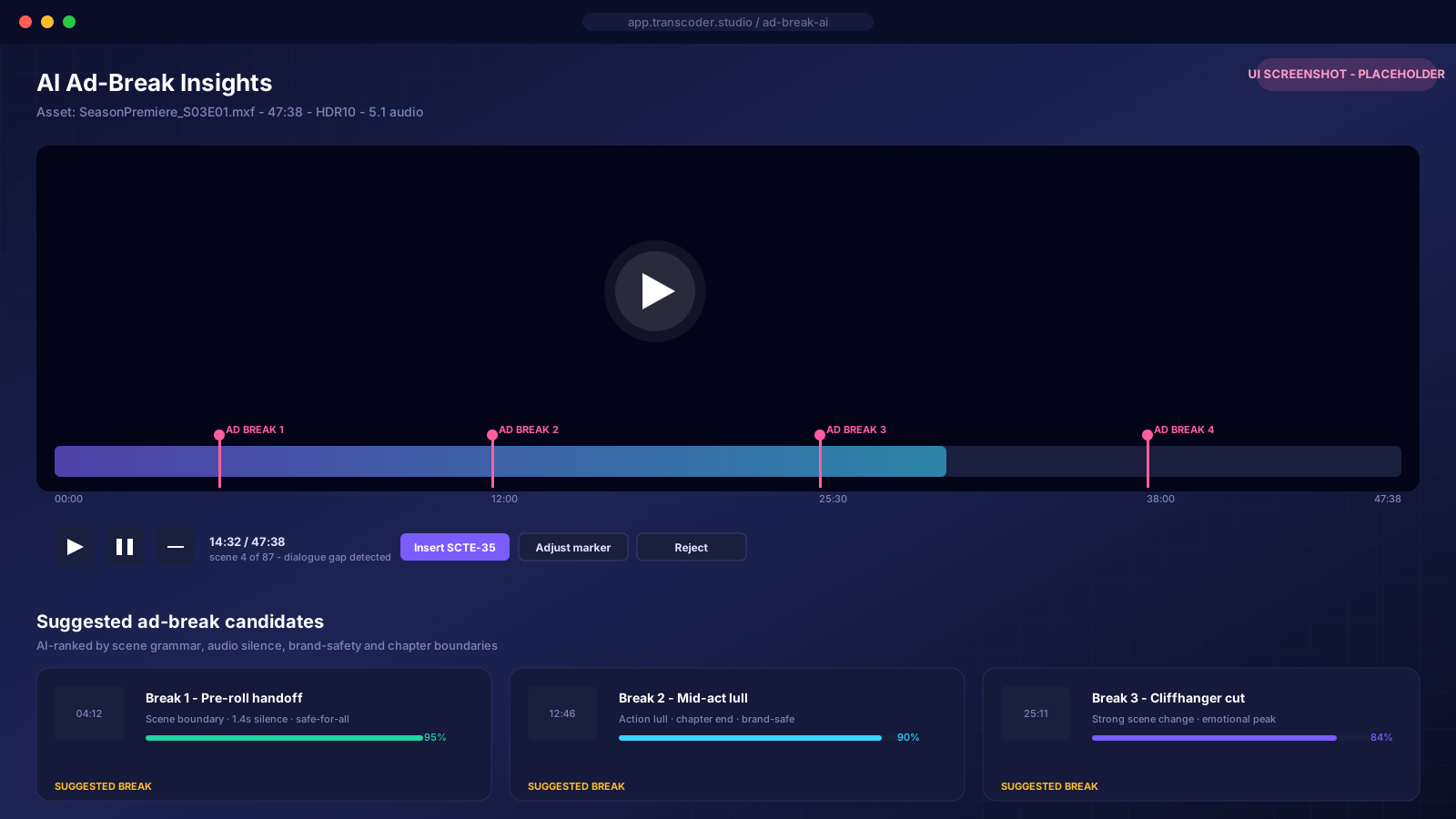
Where exactly should the ad go? We build AI modules that watch your content and answer that question precisely. By combining scene change detection, audio silence analysis, shot grammar and content-aware ML models, we identify the most natural ad-break positions — protecting viewer experience while maximising monetisation.
- AI-driven detection of optimal ad-break points: scene boundaries, dialogue gaps, action lulls and chapter transitions.
- Automatic SCTE-35 / SCTE-104 marker generation and insertion into HLS / DASH / CMAF streams.
- Brand-safety and content classification to avoid placing ads next to sensitive scenes.
Multi-microservice architecture with workers & AI agents
Video pipelines fail loudly when they fail. Ours are designed not to. We split the workflow into focused microservices — ingest, probe, transcode, package, QC, deliver — each running as an independent worker pool with strict contracts. AI agents sit on top, making decisions about routing, retries, quality fallbacks and resource allocation in real time.
- Modular microservices for ingest, probing, transcoding, packaging, QC and CDN delivery — each scalable independently.
- Worker pools on Kubernetes / Nomad with autoscaling, priority queues (RabbitMQ, NATS, Kafka) and exactly-once semantics.
- AI agents for adaptive scheduling, anomaly detection, quality scoring (VMAF/PSNR/SSIM) and self-healing recovery.
- Full observability: distributed tracing, per-asset audit logs, OpenTelemetry metrics and SLA dashboards.
Hardware-accelerated transcoding: VPU, GPU, CPU & NETINT
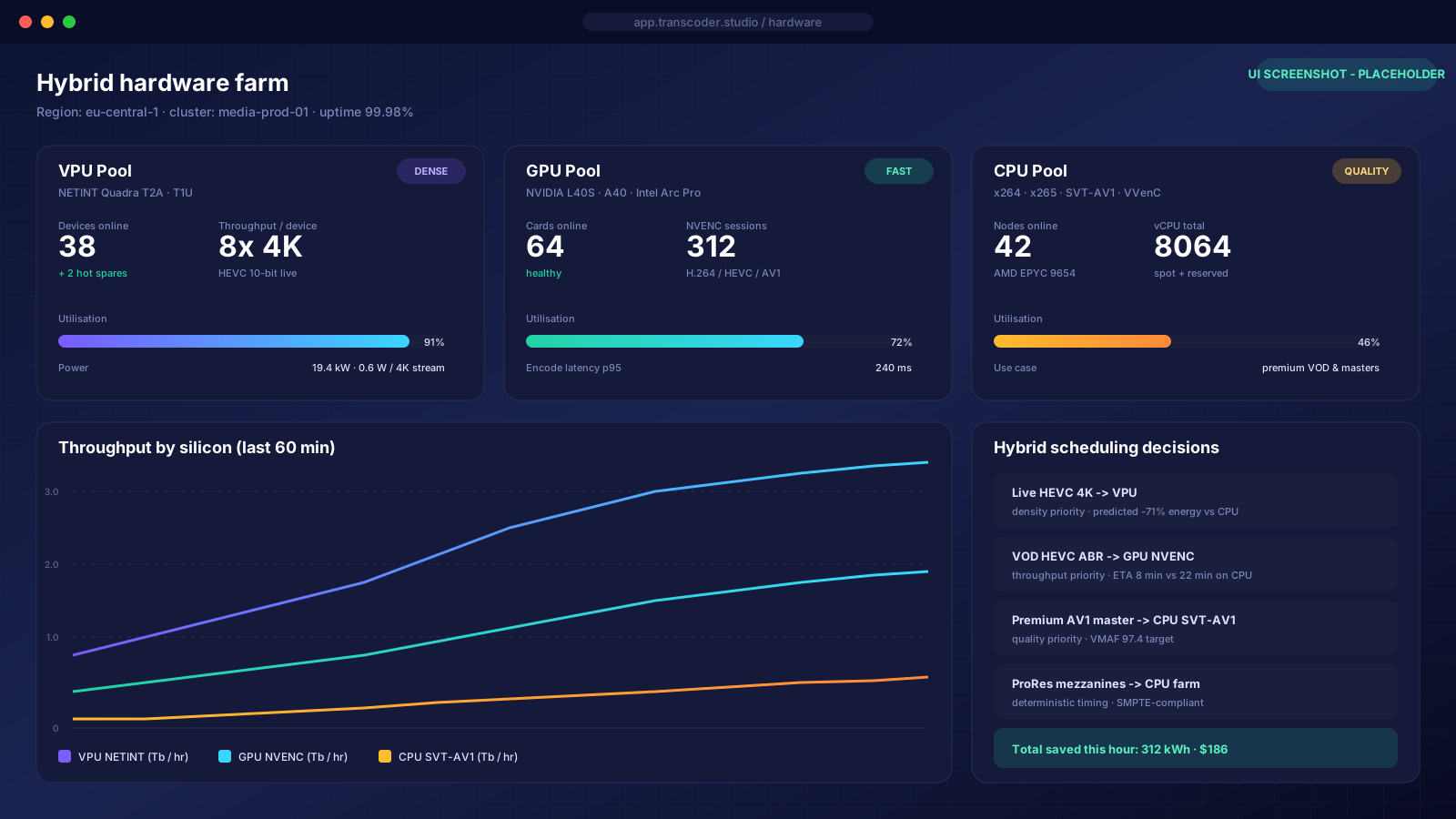
A 4K HDR encode that costs you 30 minutes on CPU can take 3 minutes on a NETINT VPU. We engineer hybrid transcoding farms that match each job to the right silicon — dedicated VPUs for high-density 24/7 channels, GPUs for AI-augmented workflows, CPUs for premium quality and edge cases — and squeeze every cent of efficiency from the hardware you own.
Our NETINT integrations are not "drop in FFmpeg, hope for the best". We work directly with the Quadra T1A and T2A series via the libxcoder SDK and the NETINT FFmpeg patches: explicit YUV pipeline routing through the on-card scaler, hardware overlay/blend for branded watermarks, AV1 encode at broadcast quality (NETINT Quadra is one of the few ASICs with hardware AV1), and AI inference on the same silicon for tasks like scene-change detection, logo masking and quality scoring. For NVIDIA we tune every NVENC parameter — preset (p1-p7), tuning info (UHQ/HQ/LL), rate-control mode (CBR-HQ / VBR-HQ), lookahead, B-frame structure and adaptive quantization — based on real per-title VMAF curves, not factory defaults. The same depth applies to Intel Quick Sync via oneVPL, AMD VCN through AMF, and CPU codecs (x264 --tune psnr/ssim, x265 --no-sao, SVT-AV1 preset 4-8, VVenC) for golden-master deliverables.
- NETINT Quadra VPU integration for ultra-dense H.264 / H.265 / AV1 encoding at broadcast quality.
- GPU acceleration with NVIDIA NVENC / NVDEC, AMD VCN and Intel Quick Sync / Arc for low-cost, high-throughput pipelines.
- CPU encoding with x264 / x265 / SVT-AV1 / VVenC tuned for premium VOD and golden-master deliverables.
- Hybrid scheduling that routes each job to the optimal accelerator — measurable savings on power, time and cloud bills.
Looking to build or modernize a video transcoding platform? Contact us to design a high-performance pipeline tailored to your formats, hardware and business goals.